
Electronic Remittance Advice (ERA) and EOB: How to Read Every Line
An electronic remittance advice (ERA) is the payer's electronic explanation of how it paid, adjusted or denied each claim. This guide shows how to read one line by line, how it differs from the EOB, and what to do next. Last reviewed 10/9/26. All patients and amounts are fictional.
Get a Free QuoteGet My Free ConsultationOn this page
What is an electronic remittance advice (ERA)?
An electronic remittance advice (ERA) is the payer's electronic explanation of payment. It lists each claim, what was billed, what was allowed, what was paid, and why any amount changed. Once Medicare adjudicates a claim, providers receive an ERA or a Standard Paper Remit that shows the final decision and payment (CMS, checked 10/9/26).
HHS adopted the X12 835 as the single ERA standard. An electronic funds transfer (EFT) is the separate message that moves the money, and a trace number ties the two together (CMS, checked 10/9/26). Related terms are in the claims processing and reimbursement glossary sections.
ERA vs EOB: who gets which
The ERA goes to the provider. The EOB goes to the patient. Both describe the same claim, so the numbers should match.
| ERA (835) | EOB | |
|---|---|---|
| Goes to | The practice or its billing service | The patient |
| Format | Electronic (X12 835) | Paper or portal |
| Shows | Billed, allowed, paid, adjustments with codes | Billed, plan discount, plan paid, patient share |
| Use it to | Post payment, find denials, plan next steps | Check what the patient was told they may owe |
| Medicare version | ERA or Standard Paper Remit | Medicare Summary Notice |
The three codes on every adjustment
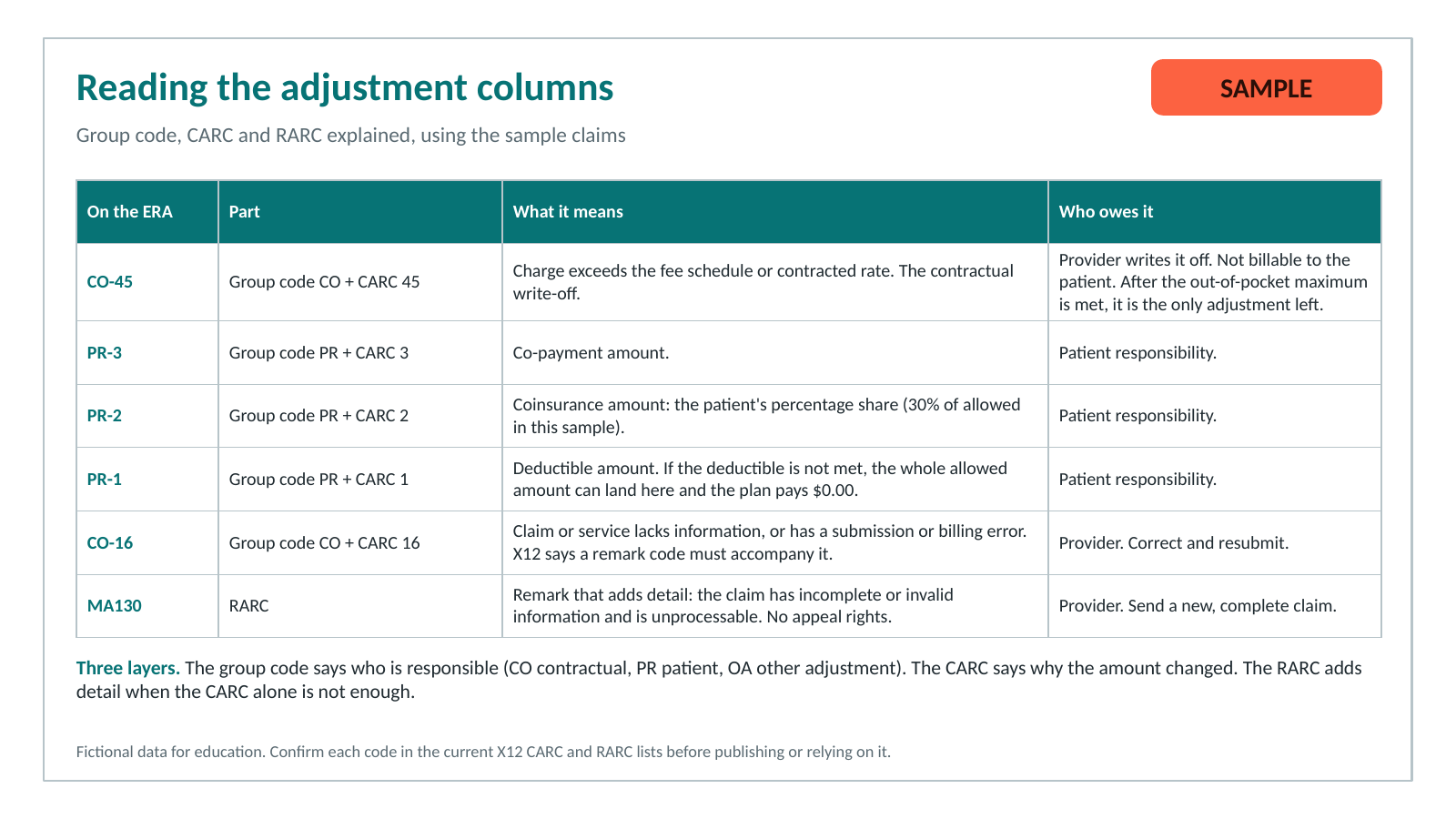
Each adjustment on an ERA can carry up to three standard codes: a claim adjustment group code, a claim adjustment reason code (CARC) and a remittance advice remark code (RARC) (CMS, checked 10/9/26).
- Group code: who owns the amount. CO is a contractual obligation. PR is patient responsibility. OA is another adjustment. PI is a payer-initiated reduction (X12, checked 10/9/26). CMS notes that Medicare may bill the patient only when PR applies.
- CARC: why the amount changed (X12 CARC list).
- RARC: extra detail when the CARC alone is not enough (X12 RARC list).
| Code | What it means | Who owes it |
|---|---|---|
| CO-45 | Charge exceeds the fee schedule, maximum allowable or contracted fee arrangement | Provider writes it off |
| PR-1 | Deductible amount | Patient |
| PR-2 | Coinsurance amount | Patient |
| PR-3 | Co-payment amount | Patient |
| CO-16 | Claim or service lacks information, or has a submission or billing error. A remark code must come with it | Provider corrects and resubmits |
| MA130 | Incomplete or invalid information, unprocessable, no appeal rights | Provider sends a new, complete claim |
A sample ERA, line by line
Six fictional claims paid by "Sample Health Plan." Total payment is $411.00 by EFT, trace number SAMPLE-000123, dated 10/01/2026.
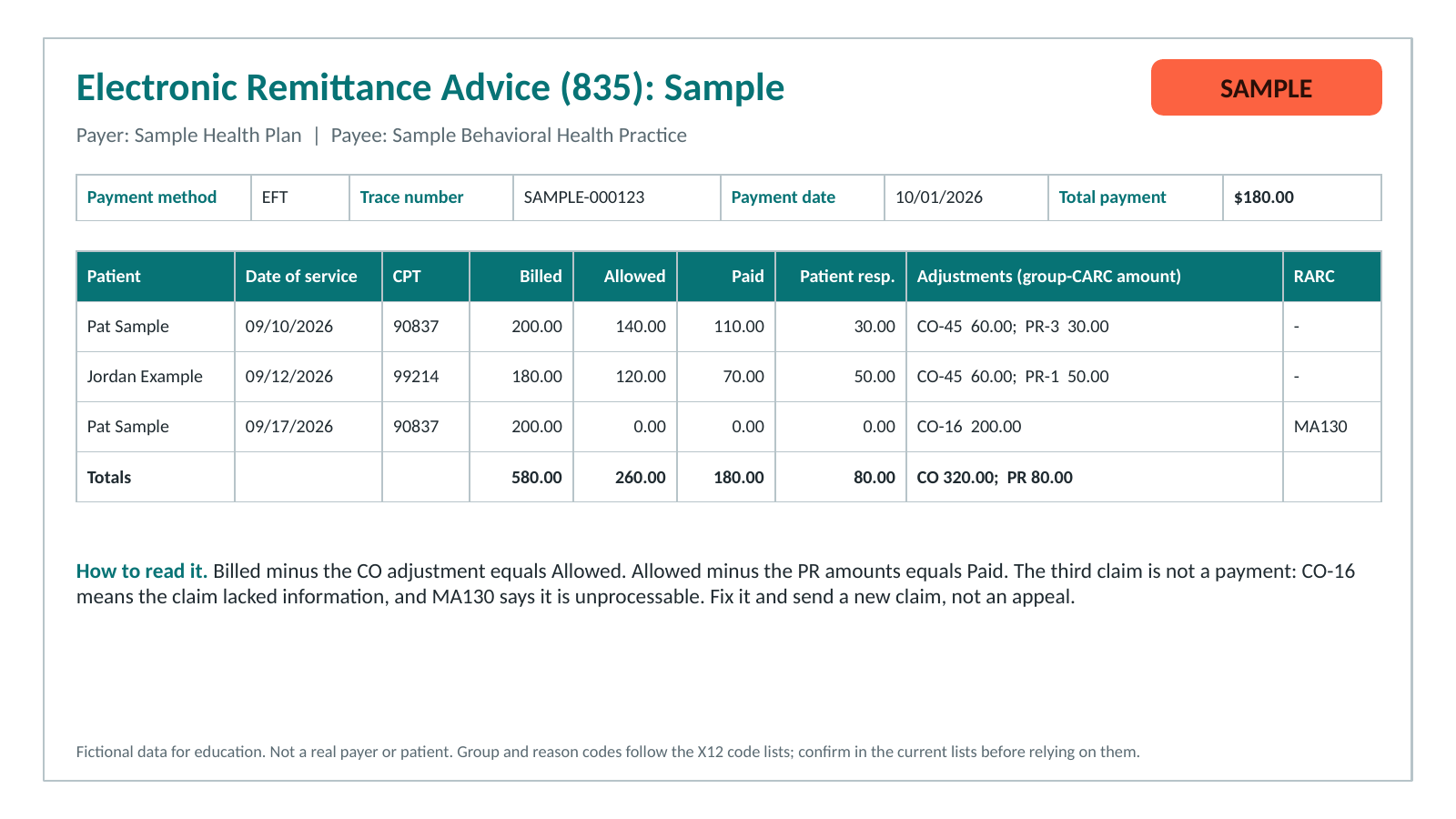
| Patient | Date of service | CPT | Billed | Allowed | Paid | Patient resp. | Adjustments | RARC |
|---|---|---|---|---|---|---|---|---|
| Pat Sample | 09/10/2026 | 90837 | 200.00 | 140.00 | 110.00 | 30.00 | CO-45 60.00; PR-3 30.00 | none |
| Jordan Example | 09/05/2026 | 99214 | 180.00 | 120.00 | 0.00 | 120.00 | CO-45 60.00; PR-1 120.00 | none |
| Jordan Example | 09/12/2026 | 99214 | 180.00 | 120.00 | 63.00 | 57.00 | CO-45 60.00; PR-1 30.00; PR-2 27.00 | none |
| Jordan Example | 09/19/2026 | 90837 | 200.00 | 140.00 | 98.00 | 42.00 | CO-45 60.00; PR-2 42.00 | none |
| Jordan Example | 09/26/2026 | 90837 | 200.00 | 140.00 | 140.00 | 0.00 | CO-45 60.00 | none |
| Pat Sample | 09/17/2026 | 90837 | 200.00 | 0.00 | 0.00 | 0.00 | CO-16 200.00 | MA130 |
| Totals | 1,160.00 | 660.00 | 411.00 | 249.00 | CO 500.00; PR 249.00 |
Check the math. Billed minus the CO adjustment equals allowed. Allowed minus the PR amounts equals paid. Check it before you post.
Five payment situations you will see
CPT 90837 is a 60-minute psychotherapy session. CPT 99214 is an established-patient office visit, the common code for psychiatric medication management. Each case shows the ERA result and what the patient's EOB says.
1. Copay
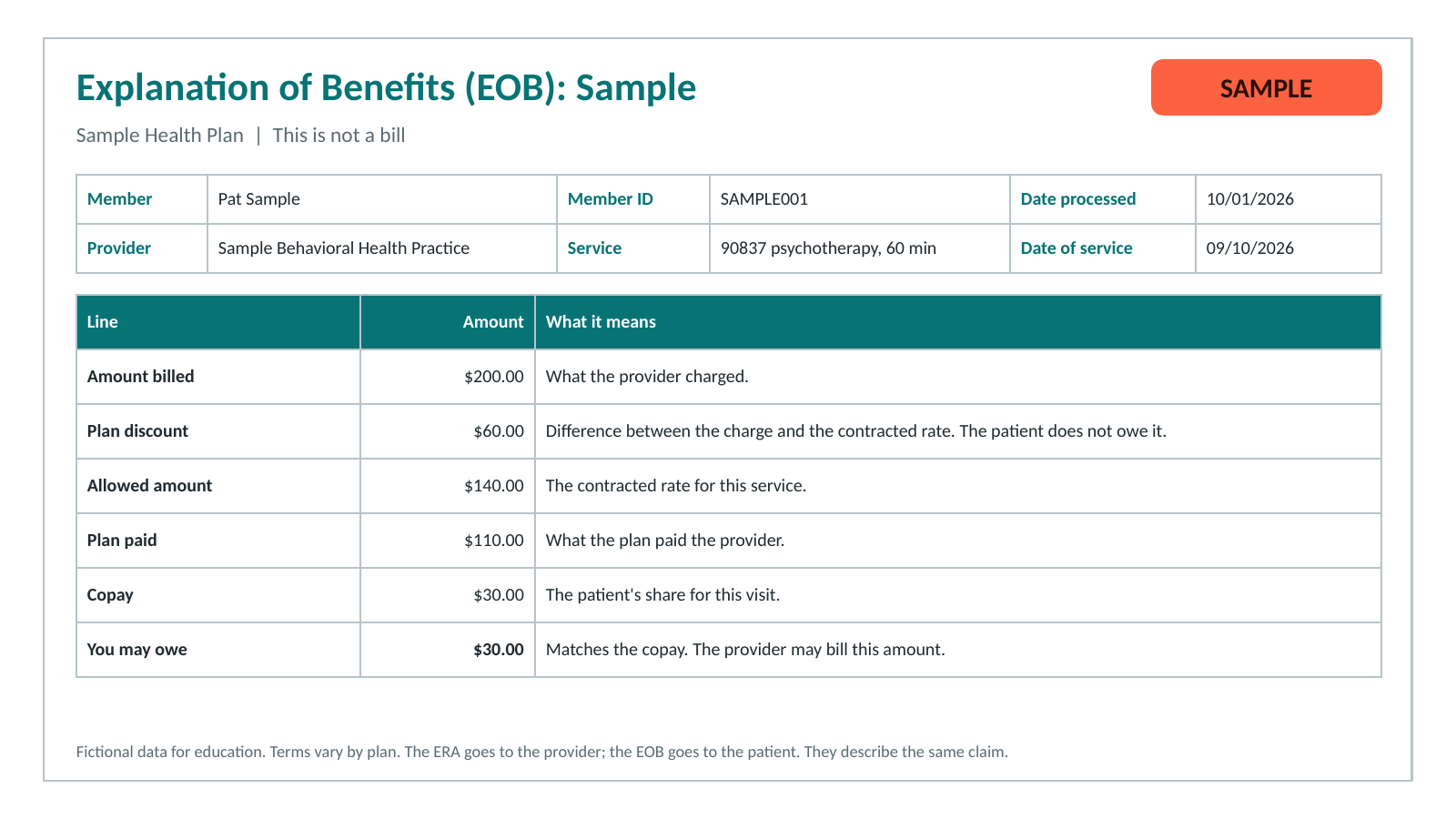
The plan pays the allowed amount minus the copay. Pat Sample's visit: allowed $140.00, copay $30.00 (PR-3), plan paid $110.00.
2. Deductible not met: the plan pays $0.00
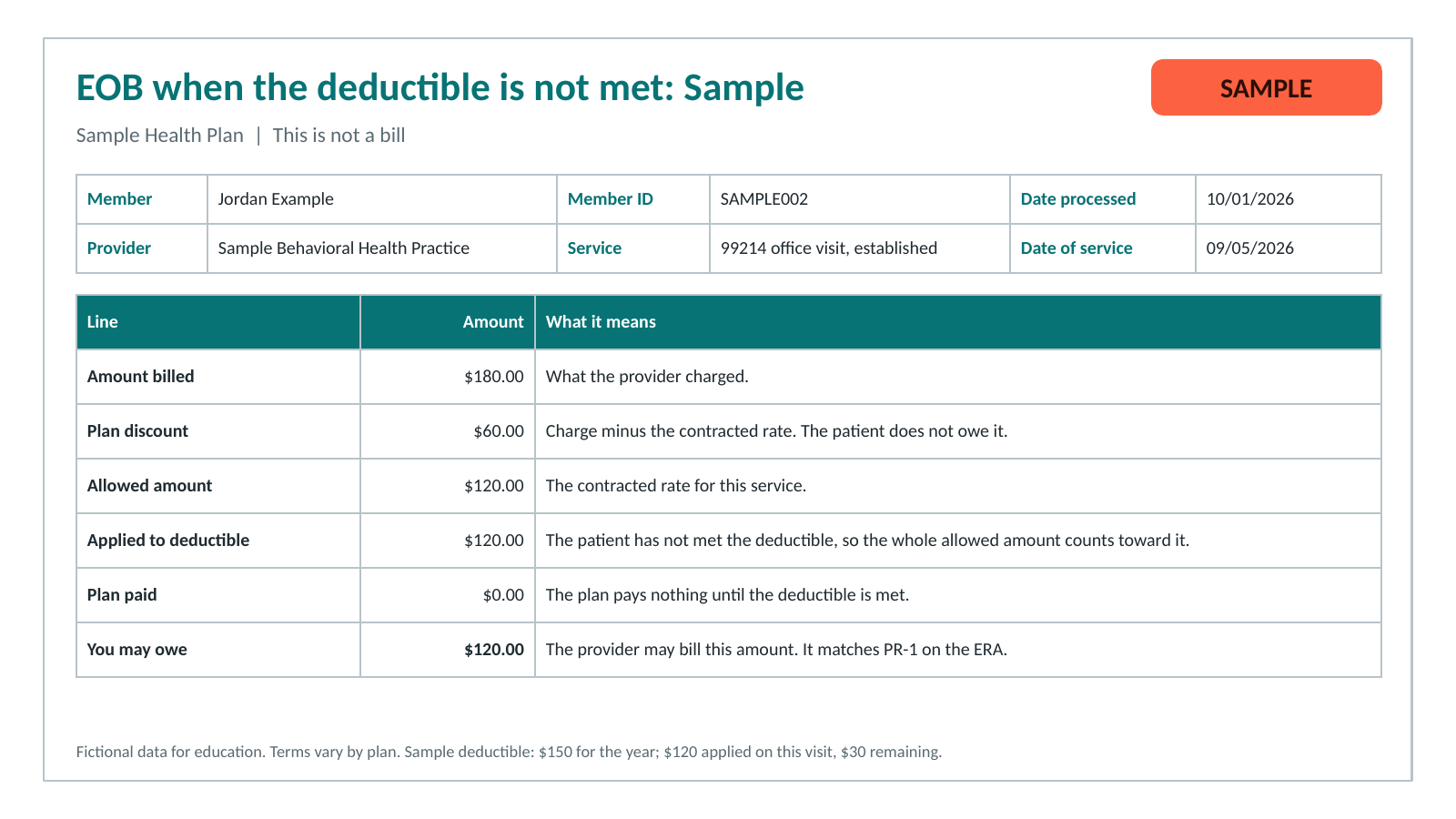
When the patient has not met the deductible, the whole allowed amount can land in PR-1. Jordan Example's 09/05 visit: allowed $120.00, PR-1 $120.00, plan paid $0.00. This is not a denial. The patient owes the allowed amount, and the practice can bill it.
3. Deductible finishes, coinsurance starts
On 09/12 the last $30.00 of the sample $150 deductible is met (PR-1). The plan then pays 70% of the remaining $90.00, which is $63.00, and the patient's 30% coinsurance is $27.00 (PR-2).
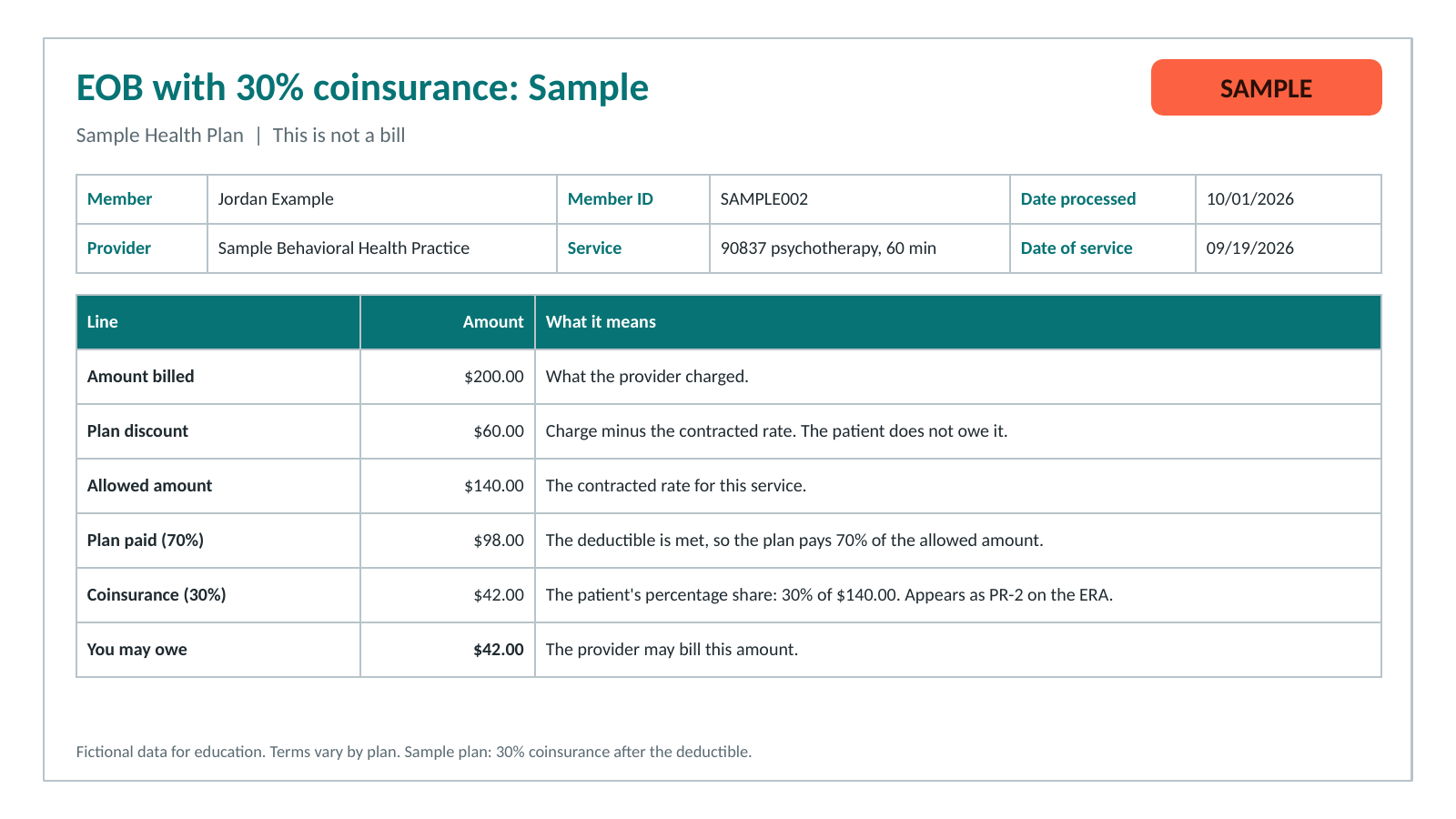
4. Coinsurance: 30%
Coinsurance is the patient's percentage of the allowed amount after the deductible. On 09/19 the allowed amount is $140.00. The plan pays 70%, $98.00. Coinsurance of 30% is $42.00 (PR-2). See also the patient financial terms in the glossary.
5. Out-of-pocket maximum reached: the plan pays 100%
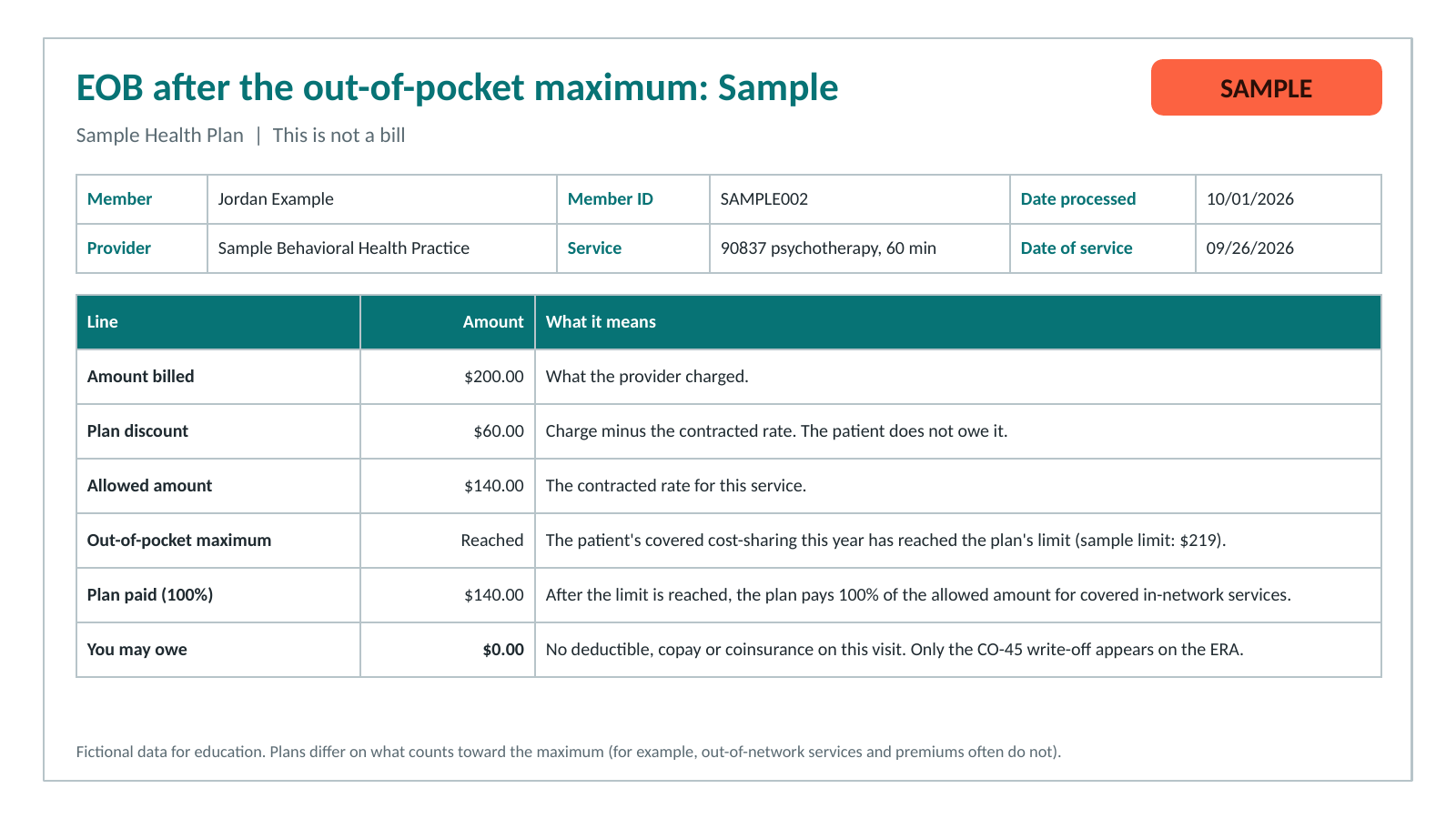
The out-of-pocket maximum is the most the patient pays in cost-sharing for covered in-network services in a plan year. After it is reached, the plan pays 100% of the allowed amount. On 09/26 the sample $219 limit is already met (120 + 57 + 42). The plan pays the full $140.00 and the only adjustment is CO-45. Plans differ on what counts toward the maximum, so check the plan.
And the denied claim: CO-16 with MA130
The last row pays $0.00 for a different reason. CO-16 says the claim lacked information. MA130 says it is unprocessable and carries no appeal rights. Do not appeal. Find the missing or invalid item, correct it, and send a new, complete claim. For appeal deadlines and levels, see Claim Denials and Appeals and the claim denial terms.
Medicare, Medicaid and private plans
Keep these separate. Rules and formats differ.
Medicare
CMS describes the ERA, the Standard Paper Remit and the three code types above. Medicare may bill the patient only for PR amounts.
Medicaid
Each state Medicaid program and each managed care plan sets its own remittance details. Check the state Medicaid provider site before you rely on an example from another state. This guide does not describe any single state.
Private payers
Each payer sets its own fee schedule, deductible, coinsurance and out-of-pocket rules. Read the payer's remittance documentation and your contract. See Private Insurances and in-network vs out-of-network.
What to do Monday morning
- Match the total payment on the EFT to the ERA total.
- Post each paid line. Recheck billed minus CO equals allowed.
- Bill the patient only the PR amounts.
- Write off CO-45 only if the amount matches your contract.
- Pull every claim with CO-16 or any denial. Correct and resubmit, or appeal, as the codes say.
MCM South posts ERAs and follows up on denials for psychotherapists and psychiatrists. See how medical billing services get paid, our billing services, and the CPT & E/M Code Guide.
Frequently asked questions about the ERA and EOB
What is the difference between an ERA and an EOB?
An ERA is the electronic payment explanation sent to the provider, in the X12 835 format. An EOB is the explanation sent to the patient. Both describe the same claim, and the amounts should agree.
What does CO-45 mean on an ERA?
CO-45 means the charge exceeds the fee schedule, maximum allowable amount or contracted fee arrangement. The CO group code puts the amount on the provider as a contractual write-off. It is not billable to the patient.
What does it mean when the plan pays $0.00 and the amount is PR-1?
PR-1 is the deductible. When the patient has not met the deductible, the allowed amount can be applied to it in full, so the plan pays $0.00 and the patient owes the allowed amount.
Does MA130 mean I can appeal?
No. MA130 says the claim has incomplete or invalid information and cannot be processed, and it carries no appeal rights. Correct the claim and send a new, complete one.
Want your remittances posted and denials followed up?
Get a free, no-pressure consultation with a specialist who only works mental and behavioral health billing.
Get a Free QuoteGet My Free ConsultationSources
Checked 10/9/26: CMS: Health Care Payment and Remittance Advice; CMS: Health Care Payment and Remittance Advice and EFT; X12 claim adjustment reason codes, remittance advice remark codes and group codes; CMS: Part A Medicare Summary Notice guide. Sample plan numbers are invented for illustration. This page is operational guidance for billing, not legal advice.
