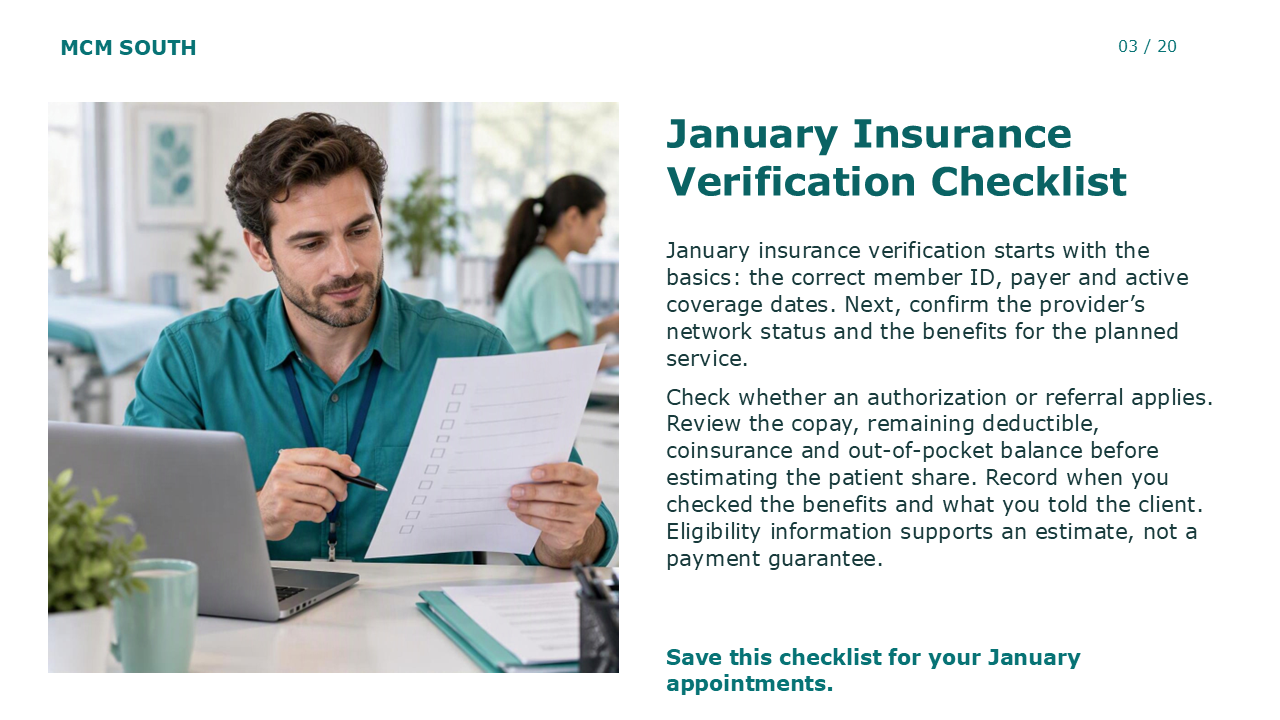
Patient Insurance Verification in January: A Practice Checklist
Patient insurance verification in January is the practice-wide recheck of every active client’s coverage after the new plan year starts. Deductibles reset, some clients change plans, and Medicare cost-sharing starts over. A short checklist now helps you catch these changes before the first claim of the year goes out.
This checklist is for psychotherapists and psychiatrists and covers private insurance and Medicare. It is operational billing guidance, not legal advice.
What is patient insurance verification, and why repeat it in January?
Patient insurance verification is the step where you confirm that a client’s coverage is active and see what the plan pays for before the visit. It is also called eligibility verification or benefit checking. In January it matters more, because many plans reset the deductible when a new plan year begins. A client who met the deductible in December may owe it again at the first visit of the year.
Not every plan year starts on January 1, so read the plan year dates in each benefits response. Verification also catches quiet changes: a new employer plan, a lapsed policy, or a move to Medicare Advantage. Our resource on eligibility checks covers the basics, and insurance verification for therapists walks through the full workflow.
Private insurance: what to confirm
Run these checks for each commercial plan. Work from the payer’s own portal or the phone number on the client’s card, not from last year’s notes.
- Active coverage: the effective date, any termination date, and the subscriber and member ID exactly as they appear on the current card.
- Network status: whether your practice is in-network, out-of-network or not yet credentialed with the plan. See in-network vs out-of-network credentialing.
- Mental health benefits: covered services, visit limits, and whether behavioral health runs through a separate vendor.
- Cost sharing: the deductible and the amount met so far, the out-of-pocket maximum, and the copay or coinsurance.
- Authorization: whether the plan requires prior authorization for psychotherapy or psychiatric visits.
- Telehealth: whether the plan covers video visits and which place-of-service code it wants. See telehealth billing for therapists.
- Other coverage: whether the client has a second plan and which plan is primary.
Write what you learn in the client’s record, with the date and the payer representative’s name or call reference if you phoned.
Medicare: what to confirm
Medicare rules are federal. Private payers and Medicaid do not follow them, so run this check separately from your commercial plans.
Have the client’s Medicare Beneficiary Identifier, first and last name, and date of birth ready. CMS lists three ways to check eligibility: your Medicare Administrative Contractor’s online portal, a clearinghouse or billing vendor, or HETS, the HIPAA Eligibility Transaction System. The response shows a Medicare Advantage plan if the client has one, and CMS says to send eligibility queries to the plan it names (CMS MLN8816413, November 2025).
The Part B deductible applies once each calendar year, and Original Medicare generally pays 80% afterward, with the client owing 20% coinsurance when you accept assignment. Medicare.gov lists the 2026 Part B deductible as $283. Confirm the new year’s amount there before you quote it (checked October 24, 2026). Counselors and MFTs can also read our guide to LPC, LMHC and MFT billing.
How to run a January verification: 6 easy steps
- Pull your active client list and flag everyone with a visit in the first weeks of the year.
- Ask those clients for a new card or any plan change before the visit.
- Run the eligibility check: the payer portal for private plans, and a MAC portal or clearinghouse (which use HETS data) for Medicare.
- Record coverage dates, network status, benefits, deductible met, and authorization rules.
- Compare the results to last year’s record and mark every change.
- Update your cost-share notes so front-desk staff quote the right amount at check-in.
What to do when verification shows a change
Match the change to the fix. A lapsed policy means holding claims and asking the client for new coverage details. A new plan means a new network check and, if you are out-of-network, a review of how you bill that plan. Coverage that ended with a retroactive eligibility change can lead a payer to take back earlier payments, so note the dates. Update the amount you record as patient responsibility.
To reach the right payer department, use our insurance companies contact directory.
How does MCM South help with patient insurance verification?
MCM South is a medical billing service that works only in mental and behavioral health. We serve psychotherapists and psychiatrists in solo and medium-size practices, and we handle patient insurance verification as part of the billing work we do for clients. Our insurance verification service explains how it works, and Who We Serve shows the practices we support.
Patient insurance verification: the short version
Patient insurance verification in January means rechecking coverage dates, network status, benefits, deductible status and authorization rules for each active client, on private plans and Medicare. Do it before the first visit of the year, write down the results, and update your cost-share notes. Browse more guides in the Resources hub, and see practice management tips for the front-desk side.
Keep going
Related reading
Patient insurance verification FAQ
What is patient insurance verification?
Patient insurance verification is the step where a practice confirms that a client’s coverage is active and checks what the plan covers before the visit. It includes coverage dates, network status, mental health benefits, the deductible and authorization rules.
Why verify insurance again in January?
Many plans reset the deductible and may change benefits when a new plan year starts, and clients sometimes switch plans or lose coverage over the holidays. A January recheck catches these changes before claims go out. Not every plan year starts on January 1, so read the plan year dates in each response.
How do I check Medicare eligibility?
Use your Medicare Administrative Contractor’s online portal, a clearinghouse or billing vendor, or HETS, the HIPAA Eligibility Transaction System. You need the client’s Medicare Beneficiary Identifier, name and date of birth. Source: CMS MLN8816413, November 2025.
Does an eligibility check guarantee payment?
No. A check shows coverage and benefits at the time you ask. A payer can still deny a claim for other reasons, such as authorization, coding or timely filing, so record what you verified and when.
Does MCM South verify insurance for existing clients?
Insurance verification is part of the billing work MCM South does for clients. See our insurance verification service page for how it works.
Where MCM South works
MCM South works only in mental and behavioral health. We serve psychotherapists and psychiatrists in solo and medium-size practices across ten currently served states: Georgia, Massachusetts, Connecticut, Texas, Florida, New York, Colorado, Tennessee, North Carolina and Illinois. Need a payer contact? Use our insurance companies contact directory.