How Therapists Pay Their Billing Service: 3 Easy Steps
How therapists pay their billing service comes down to one monthly cycle. Insurance pays your practice for finalized sessions. Your billing service then sends a paysheet and an invoice together at the end of the month. This short guide shows what that looks like for psychotherapists and psychiatrists. For the full walkthrough, read our guide on how medical billing services get paid.
Knowing how therapists pay their billing service makes your monthly paysheet easier to read, and it helps you spot a number that looks off.
What is a finalized session?
A finalized session is a date of service (DOS) that the insurance company has completely processed. The allowed amount, the patient’s share and the insurance payment are all decided. Sessions still pending, rejected or in appeal are not finalized. Our denied and rejected claims follow-up keeps those moving.
Where the month-end list comes from
This list is the base for how therapists pay their billing service each month.
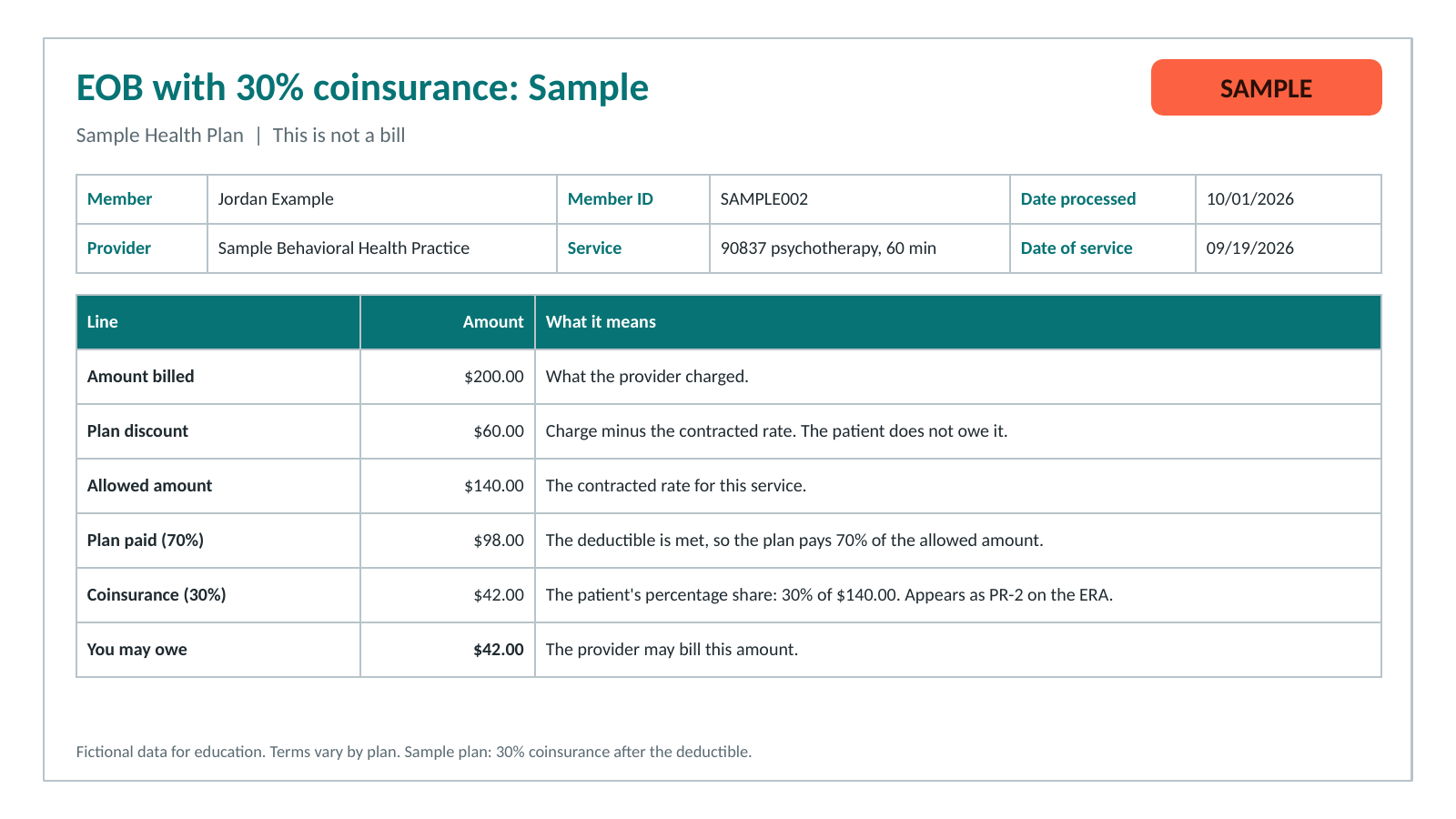
The insurance company sends an explanation of benefits (EOB) or an electronic remittance advice (ERA) for each processed claim. Your billing service posts those payments. At month-end it builds the paysheet from them. The paysheet lists each patient session that was finalized and the insurance reimbursement, and the billing service invoice comes with it.
The Centers for Medicare & Medicaid Services (CMS) describes remittance advice as the payer notice that carries final claim payment and adjustment information (checked 10/3/2026).
Billed rate, allowed rate and adjustment: three payment examples
These three examples show how therapists pay their billing service under different patient benefits.
Billed rate, allowed rate and adjustment: plain definitions
- Billed rate (also called the billed charge): the fee a provider lists for a service on the claim form, before any adjustment.
- Allowed rate (also called the allowed amount): the most a payer will recognize for a covered service.
- Adjustment (also called the contractual adjustment): the part of the billed rate a participating provider writes off because it is above the allowed rate. It cannot be collected from the patient.
In plain math, billed rate minus allowed rate equals the adjustment. The allowed rate is then split between the patient’s share and the insurance payment.
The numbers below are round examples only. They are not a fee schedule, a payer rate or an MCM South rate.
Option #1: Patient $30 copayment (copay)
| Example | Billed | Allowed | Adjustment | Patient owes | Insurance pays |
|---|---|---|---|---|---|
| 90837 psychotherapy, 60 min · $30 copay | $200 | $130 | $70 | $30 | $100 |
| 99213 established visit · $30 copay | $150 | $90 | $60 | $30 | $60 |
Option #2: Patient has not met their deductible
The patient pays 100% of the allowed rate until the deductible is met, so insurance pays $0.
| Example | Billed | Allowed | Adjustment | Patient owes | Insurance pays |
|---|---|---|---|---|---|
| 90837 psychotherapy, 60 min | $200 | $130 | $70 | $130 | $0 |
| 99213 established visit | $150 | $90 | $60 | $90 | $0 |
Option #3: Patient has met their deductible and now pays 30% coinsurance
The patient pays 30% of the allowed rate. Insurance reimburses the remaining amount.
| Example | Billed | Allowed | Adjustment | Patient owes | Insurance pays |
|---|---|---|---|---|---|
| 90837 psychotherapy, 60 min | $200 | $130 | $70 | $39 | $91 |
| 99213 established visit | $150 | $90 | $60 | $27 | $63 |
All claims are finalized. These are round numbers for illustration only, not a fee schedule, payer rate or MCM South rate. Plans differ, so verify each one.
If the deductible is not met, the whole allowed amount can become the patient’s responsibility, and insurance pays $0 on a finalized claim. Rules differ by plan and by state, so verify each plan.
For psychiatrists: prescribers usually bill an evaluation and management (E/M) code such as 99213 and may add a psychotherapy add-on code (for example 90833) when it applies. See our E/M code guide. Each line is allowed and paid on its own.
How therapists pay their billing service, step by step
Here is how therapists pay their billing service, from a finalized session to the invoice.
Because the paysheet and the invoice arrive together, you can match what insurance paid against what you owe the billing service. How the fee is set is part of your billing agreement, so ask for it in writing before you sign.
What to review on your paysheet
Check these items each month. They are the quickest way to confirm how therapists pay their billing service in your practice and that the numbers match.
- Every session you saw is listed or has a reason it is not finalized.
- The allowed amount matches your plan terms.
- Patient responsibility matches the copay, deductible or coinsurance. Start with insurance verification to avoid surprises.
- Any unfamiliar term is in our billing terms glossary.
How the fee is set belongs in your billing agreement. Ask for it in writing.
Next step
Now you know how therapists pay their billing service and what to check on the paysheet.
See our mental health billing services or get a free quote. Not sure how therapists pay their billing service in your own practice? Ask us before your next month-end.
States we serve
MCM South Medical Billing Service, LLC currently serves practices in Georgia, Massachusetts, Connecticut, Texas, Florida, New York, Colorado, Tennessee, North Carolina and Illinois. Payer rules and patient cost-share vary by state and plan, so verify each plan.