
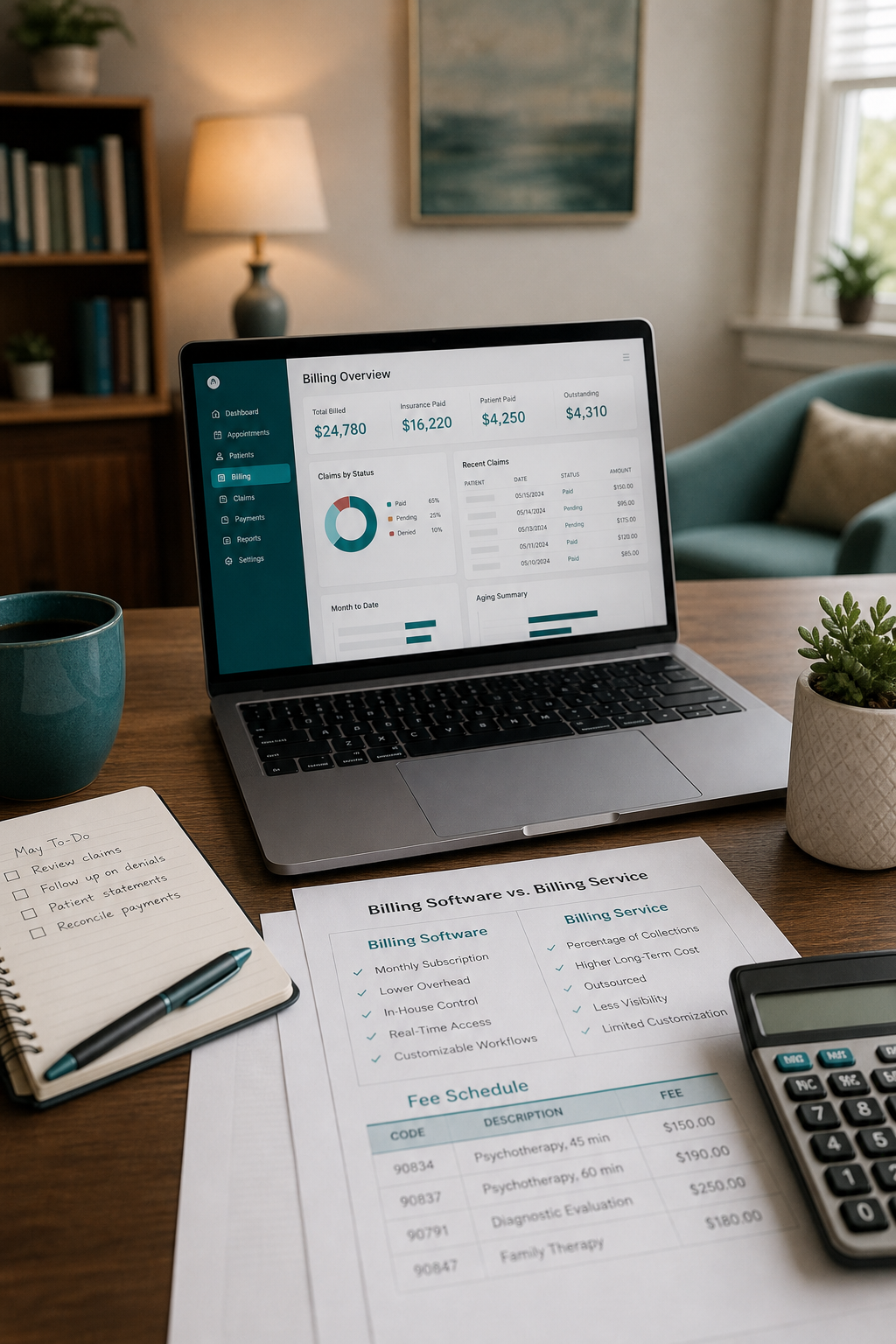
Mental Health Billing Software vs Service: Key Differences
You run a mental health practice. You want to focus on your patients, not on insurance paperwork. But billing is a big part of keeping your doors open. So you have a choice: use billing software and do it yourself, or hire a billing service and let them handle it. Which one is right for you? In this article, we break down the key differences between mental health billing software and a full billing service. We look at cost, control, time, expertise, and scalability. By the end, you’ll know exactly what fits your practice.
Cost and Pricing Models
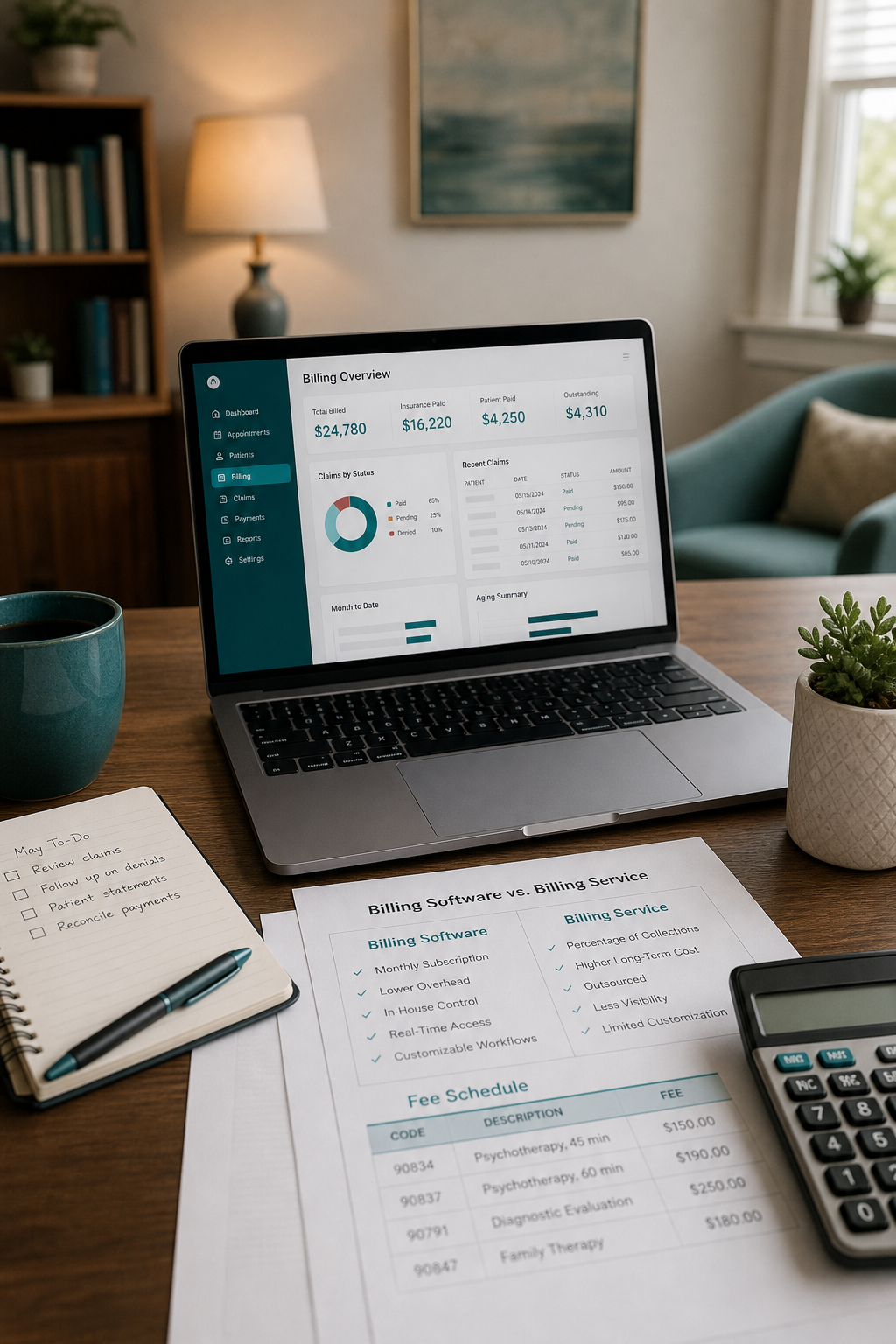
The biggest difference between software and a service is how you pay. Billing software usually charges a monthly subscription. For mental health practices, popular platforms among mental health practices cost between $50 and $150 per month. Some charge a percentage of collections, but most are flat fees. You pay that fee regardless of how many claims you submit or whether they get paid.
A billing service, on the other hand, typically charges a percentage of what they collect. For mental health billing, that’s usually 5% to 10% of your monthly revenue. So if you collect $10,000 in a month, you pay $500 to $1,000. If you collect nothing, you pay nothing. That aligns their incentives with yours: they only get paid when you get paid.
But there’s more to the math. With software, you also pay for your own time. A solo therapist seeing 25 patients a week at $150 per session should be collecting $195,000 per year. At an 82% net collection rate , common for self-managed billing , that therapist collects $159,900. That’s a $35,100 gap due to billing inefficiency. When you use software, you’re doing the work yourself. That means hours every week on eligibility checks, claim submission, denial follow-up, and patient statements. According to industry data, behavioral health providers spend over 20% more time on admin than the average physician. If you spend 5 hours a week on billing, that’s $39,000 in lost clinical time at $150 per hour.
With a billing service, you trade that percentage for time and peace of mind. You also get expertise that reduces denials. A good service can boost your net collection rate to 95% or higher. For that same solo therapist, a 95% collection rate means $185,250 collected , a $25,350 increase over self-managed billing. Even after paying the service fee (say 8% = $14,820), you keep an extra $10,530. And you get back those 5 hours per week.
Control and Customization

When you use billing software, you control every step. You choose which clearinghouse to use. You decide how to handle denials. You set your own fee schedules. That level of control appeals to practices that want to micromanage every claim. But it also means you’re responsible for staying up to date with changing payer rules, CPT code updates, and state regulations.
With a billing service, you give up some control. But you gain a team that handles those details for you. A good service like MCM South specializes in mental health billing. They know the carve-out networks, the time-based coding requirements, and the common denial reasons. They handle eligibility verification, claim submission, denial management, and patient statements. You still maintain clinical control , you decide treatment plans and documentation , but the billing logistics are off your plate.
Customization is another angle. Software lets you tailor claim forms, patient statements, and reports to your exact preferences. But that customization takes time to set up and maintain. Services offer less customization because they use standardized workflows. However, many services offer dedicated account managers who can adapt to your practice’s unique needs. The trade-off is between full control with time investment versus delegated control with expertise.
Think about it this way: if you love digging into spreadsheets and tweaking billing rules, software might be your thing. But if you’d rather trust experts and focus on therapy, a service is better. According to industry comparisons, practices that outsource billing report higher satisfaction and less stress, even though they sacrifice some hands-on control.
Time and Administrative Burden
Time is your most valuable resource. Every hour you spend on billing is an hour you’re not seeing patients. For mental health professionals, that opportunity cost is high. A therapist billing $150 per session loses that amount for every non-clinical hour.
Billing software doesn’t eliminate the work; it just gives you the tools to do it yourself. You still need to verify patient benefits, submit claims, track denials, follow up on unpaid claims, post payments, and send patient statements. Those tasks add up quickly. A solo provider can easily spend 10-15 hours per month on billing. That’s time that could go toward seeing more patients or improving your practice.
A billing service takes that burden entirely. They handle the full revenue cycle: eligibility verification before each visit, claim submission within 24-48 hours, denial appeal management, and monthly reporting. You simply send your encounter data (often through your existing EHR) and they do the rest. For many providers, this cuts their billing-related tasks to under an hour per week.
The administrative burden isn’t just about hours; it’s about mental load. Billing stress contributes to burnout. According to SAMHSA, behavioral health providers face high rates of burnout, and administrative burden is a key factor. Outsourcing billing can reduce that stress significantly, allowing you to focus on clinical care.
The choice between software and service really comes down to how you value your time. If you’re growing your practice and want to maximize patient hours, a service makes sense. If you’re just starting and have extra time, software might work until you scale.
Expertise and Revenue Cycle Management
Billing mental health claims is different from general medical billing. You deal with time-based CPT codes (90834, 90837), carve-out networks, prior authorization requirements, and specific documentation rules. A coding or billing mistake can lead to denials or audits. Software can help with templates and claim scrubbing, but it doesn’t replace human expertise.
A specialty billing service brings certified coders who know the nuances of mental health billing. They understand that 90837 requires at least 53 minutes of face-to-face time. They know which modifiers to use for telehealth. They track timely filing deadlines and appeal denied claims. According to industry reports, specialized mental health billing services achieve clean claim rates above 95% and reduce A/R days to under 30. That’s hard to match with software alone.
Revenue cycle management (RCM) is more than just submitting claims. It includes denial management, payment posting, patient collections, and reporting. Software gives you reports, but you have to interpret them. A service provides monthly analytics with actionable insights. They flag underpayments, identify payer trends, and help you optimize fee schedules.
For example, MCM South offers full RCM for mental health practices. They handle everything from eligibility to final payment. Their team knows the common denial reasons for behavioral health , like missing prior authorization or incorrect place of service , and they have processes to prevent them. That expertise directly impacts your bottom line.
If you have the knowledge and time to manage RCM effectively, software can be sufficient. But if you want best-in-class results without the learning curve, a specialized service is the way to go.
Scalability and Support
As your practice grows, so do your billing needs. Software can scale to handle more claims, but you’ll need to invest more time or hire internal staff. Many practices start with software, then realize they need a billing service once they hit 10-15 patients per week or add another provider. The administrative load multiplies with each new therapist.
A billing service scales naturally. They have the infrastructure to handle growing volume without adding to your workload. Whether you have two providers or twenty, the service adapts. They also provide support when issues arise. If a claim is denied, they investigate and appeal. If a payer changes a rule, they update their workflows. You don’t need to stay on top of every change.
Support is another differentiator. Software companies offer customer support for their product, but they don’t help you with specific claim issues. A billing service has a dedicated team that knows your practice and your payers. At MCM South, you get a dedicated account manager who understands your unique setup. They’re proactive, not reactive.
For practices that plan to grow, outsourcing billing early saves the headache of transitioning later. It also ensures consistency in your revenue cycle. You can focus on opening new locations or adding services while the billing team keeps cash flow steady.
To learn more about how MCM South supports mental health practices, check out our billing service offerings. We specialize in behavioral health billing so you can focus on patients.
Frequently Asked Questions
What is the main difference between mental health billing software and a billing service?
Mental health billing software is a tool you use to manage your own billing. You pay a flat monthly fee and handle all tasks yourself. A billing service is a team that does the billing for you, typically charging a percentage of collections. Software gives you control but costs your time. A service saves time but costs more upfront.
Is billing software or a service better for a solo therapist?
For solo therapists just starting, software may be more affordable and let you learn the process. However, many solo providers quickly find that billing distracts from patient care. A service can boost collections and free up time, often paying for itself through higher reimbursement rates and fewer denials.
How much does mental health billing cost per month?
Billing software costs $50, $150 per month for a solo practitioner. A billing service charges 5, 10% of monthly collections. For a therapist collecting $10,000 per month, that’s $500, $1,000. But a service often increases net collections by 10-15%, so the effective cost may be neutral or even negative when factoring in time savings.
Can I use both billing software and a billing service?
Yes. Some practices use software for basic tasks and a service for complex claims or overflow. For example, you might use software to generate claims and then have a service handle denials and follow-up. However, most practices find it simpler to choose one approach. Many billing services integrate with popular EHR/software platforms.
How does revenue cycle management differ between software and service?
With software, you manage the entire revenue cycle yourself: eligibility, claims, payments, denials, and reporting. With a service, the provider handles all of that. Software requires you to learn RCM; a service provides experts who optimize each step. Services typically achieve faster payment cycles and higher collection rates.
What should I look for in a mental health billing service?
Look for experience with behavioral health, certified coders, transparent reporting, denial management, and good communication. Check if they handle carve-out networks and prior authorization. Ask about their clean claim rate and average days in A/R. MCM South, for example, specializes in mental health and offers dedicated account management.
Is billing software secure for patient data?
Reputable billing software is HIPAA compliant and uses encryption. However, you are responsible for securing your own systems and training staff. A billing service also must be HIPAA compliant, and they invest in enterprise-level security. Many therapists find outsourcing reduces their own security liability.
How do I decide between software and a service for my practice?
Consider your time, budget, and comfort with billing tasks. If you have extra time and want full control, start with software. If you want to maximize clinical hours and reduce stress, choose a service. Also consider your growth plans: a service scales more easily than software with added providers.
Conclusion
Choosing between mental health billing software and a billing service is a big decision. It affects your finances, your time, and your sanity. Software offers control and lower upfront costs but demands your time and billing expertise. A service offers convenience, expert revenue cycle management, and higher net collections, but at a percentage of revenue.
We’ve seen many therapists start with software and eventually switch to a service as their practice grows. The key is to be honest about how you value your time. If you’d rather spend your evenings with family than on claim follow-up, a service is worth every penny. If you enjoy managing the business side and have the bandwidth to stay current with payer rules, software might work.
Whichever path you choose, make sure it aligns with your goal: providing excellent care to your patients without burning out. At MCM South, we believe billing should be in the background, not the spotlight. We help mental health professionals thrive by handling the insurance maze. If you’re ready to explore how a specialized mental health billing service can support your practice, reach out. We speak insurance, so you don’t need to.